Which Spanish tenses do native speakers actually use? We counted 40,000 verbs
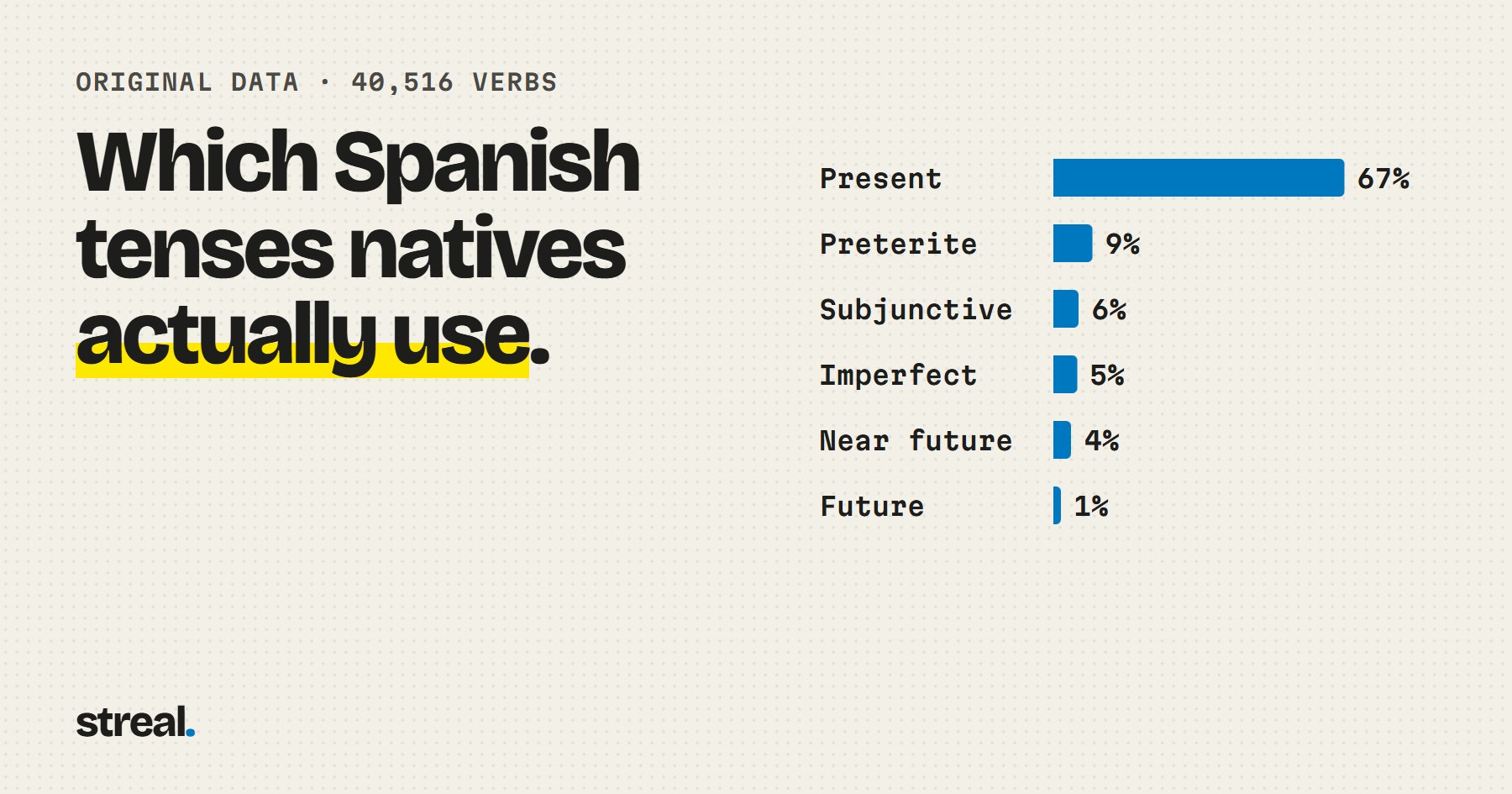
We ran about 40,000 conjugated verbs from native Spanish YouTube videos through a grammar analyser. Two thirds were in the present tense. People said “voy a comer” three times as often as “comeré”. The subjunctive, which many learners leave until last, came up about once a minute. And five verbs made up 45% of all the verb forms we counted.
Spanish grammar books give every tense roughly a chapter each, which quietly suggests they matter about equally. They do not. Knowing what speakers actually reach for tells you what to learn first, what to hear next, and what you can safely put off. So we counted, across 140 native videos and 32 hours of speech.
Five things stand out.
1. Two verbs in three are in the present
The present alone is 67%. Every past tense combined is about 18%. Some of that comes from the medium, since YouTubers spend a lot of time describing what is on screen, and a sample of novels would come out differently. But the lesson for a beginner holds: the present, including its irregular verbs, is what you will hear most, for a long time. Time spent getting it automatic is never wasted.
2. People say “voy a comer”, not “comeré”
The near future with ir a outnumbers the simple future about three to one (1,711 against 581). It is also far easier, since you only need the present of ir and an infinitive, and you can use it at A1. If you are putting off talking about plans until you have learned the future endings, you do not need to wait.
3. The subjunctive is not an advanced topic
This is the result most likely to change what you do. Subjunctive forms were about 6% of the verbs we counted, or around one every minute of video, and only 3 of the 140 videos had none. The present subjunctive alone came up about twice as often as the simple future and conditional put together, and about as often as the imperfect.
Most courses bring it in late, usually around B1, which is fair for producing it. It is a difficult thing to use well. But you are hearing it from your very first native video. Which suggests a practical order: learn to recognise it, in its commonest forms, well before you are expected to use it correctly.
Happily, it is concentrated. These are the forms we met most often:
| Form | Infinitive | Times counted |
|---|---|---|
| sea, sean | ser | 243 |
| esté, estén, estés | estar | 106 |
| tenga, tengas, tengan | tener | 103 |
| haya, hayan | haber | 97 |
| pueda, puedas, puedan | poder | 82 |
| vea, vean | ver | 74 |
| haga, hagas, hagan | hacer | 60 |
And it tends to follow a small number of signals. The most common one with a clear meaning was para que (“so that”), ahead of cuando, si (with the imperfect subjunctive), lo que, espero que, aunque and como si. If you learn to hear para que and expect a subjunctive after it, you have the most useful single rule of the topic.
4. The preterite leads the imperfect, but not by much
The preterite beats the imperfect by about 5 to 3 (3,670 against 2,200). Both are everyday tenses, and it is not the case that you can get far with one and pick up the other later. The present perfect comes third at 3%. The split between it and the preterite varies by region, so your own number will depend on whose Spanish you are listening to.
5. A handful of verbs do most of the work
Conjugation tables make Spanish look like an endless job. The counts show something smaller:
| Most common verbs | Share of conjugated forms | Which verbs |
|---|---|---|
| Top 5 | 45% | ser, haber, estar, tener, ir |
| Top 10 | 56% | the above, plus poder, hacer, decir, ver, saber |
| Top 20 | 66% | the above, plus querer, mirar, gustar, creer, dar, venir, quedar, parecer, pasar, llegar |
| Top 100 | 82% | out of about 2,600 different verbs in the sample |
Ser alone is almost one conjugated verb in five. Nearly all of the top ten are irregular, and that is not an accident: verbs stay irregular because people use them all the time. So these are the verbs worth drilling by hand, in every tense you know. Regular verbs follow the pattern, so one example teaches you hundreds.
An order this data suggests
Five tenses cover about 89% of the conjugated verbs we counted, and a sixth takes you to about 94%. That gives you a sensible order, whatever course or book you use:
| Learn | Running total of what you can parse | Why now |
|---|---|---|
| Present, with irregulars | 67% | Everything else builds on it |
| Near future (ir a) | 72% | Almost free once you have the present |
| Preterite | 81% | Telling what happened |
| Imperfect | 86% | Describing how things were |
| Present perfect | 89% | Easy to form, common in some regions |
| Present subjunctive, to recognise | 94% | You have been hearing it all along |
| Commands, future, conditional | 99% | Short lessons, each with a clear use |
The order is one thing, and knowing a tense is another. Being able to name a tense and being able to hear it at 3.2 words a second are different skills, and how fast Spanish speakers really talk shows why. For where each of these sits on the official scale, see the CEFR levels explained.
Learn a notion, then hear it in real speech
Streal, which is our product, is built around this gap. It is an ordered course from A1 to C2, and each grammar point comes with YouTube extracts where that notion keeps coming back. When someone uses the tense you just learned, it lights up in the subtitle as it is said, so over time a rule becomes something you expect to hear.
You can start the first lessons with no account. Video extracts are arriving in Spanish first.
How far to trust these numbers
We used spaCy’s Spanish language model to label each verb on the text of 140 videos, about 290,000 words, then corrected the errors we could catch with rules. For instance o sea and digamos are verbal tics rather than subjunctives, so we removed them, and we reclassified mira and oye as commands. Then we checked a random sample of roughly 20 forms per tense by hand.
- Treat these as orders of magnitude. Most main tenses were right about 80 to 90% of the time in our check, the imperfect subjunctive closer to 70%. A share of 5.2% means “about 5%”.
- Captions are not always accurate. A missing accent can turn encantará (future) into encantara (subjunctive), which inflates the rarer subjunctive forms slightly.
- YouTube is not all of Spanish. These are mostly one person talking to a camera about travel, food, products and ideas, and chosen for the Streal course rather than at random. Fiction, formal writing and conversation between friends would all shift the balance. The past tenses especially would go up in storytelling.
- The sample mixes regions and is not balanced by country. We make no claim about differences between them.
- The list of signals for the subjunctive is partial. We looked up to five words back and over a quarter of the forms had no signal we had listed, so it shows which triggers are common, not their exact share.
All figures are our own counts, November 2026. The video sample is described in full under how we measured.
FAQ
What is the most used tense in Spanish?
The present indicative, by a wide margin. It made up about 67% of the conjugated verbs in our sample of native Spanish YouTube videos, or two verbs in three.
How common is the subjunctive in spoken Spanish?
More common than most learners expect. It was about 6% of conjugated verbs in our videos, around one form a minute of video. The present subjunctive alone came up about twice as often as the simple future and the conditional put together.
Do Spanish speakers use the simple future?
Yes, but much less than “ir a” plus an infinitive. In our counts “voy a comer” forms outnumbered “comeré” forms by about three to one. Learn “ir a” first and you can talk about the future right away. Then learn the simple future so you can understand it.
Which Spanish tenses should I learn first?
The present, then near future with “ir a”, then the preterite and the imperfect, then the present perfect. Those five made up about 89% of the conjugated verbs we counted. The present subjunctive takes you to about 94%.
What are the most common verbs in Spanish?
In our counts: ser, haber, estar, tener, ir, poder, hacer, decir, ver and saber. The first five made up 45% of conjugated forms, and the ten together 56%. Most of the haber count is “hay” and the auxiliary in forms such as “he comido”.