How fast do Spanish speakers really talk? We measured 140 YouTube videos
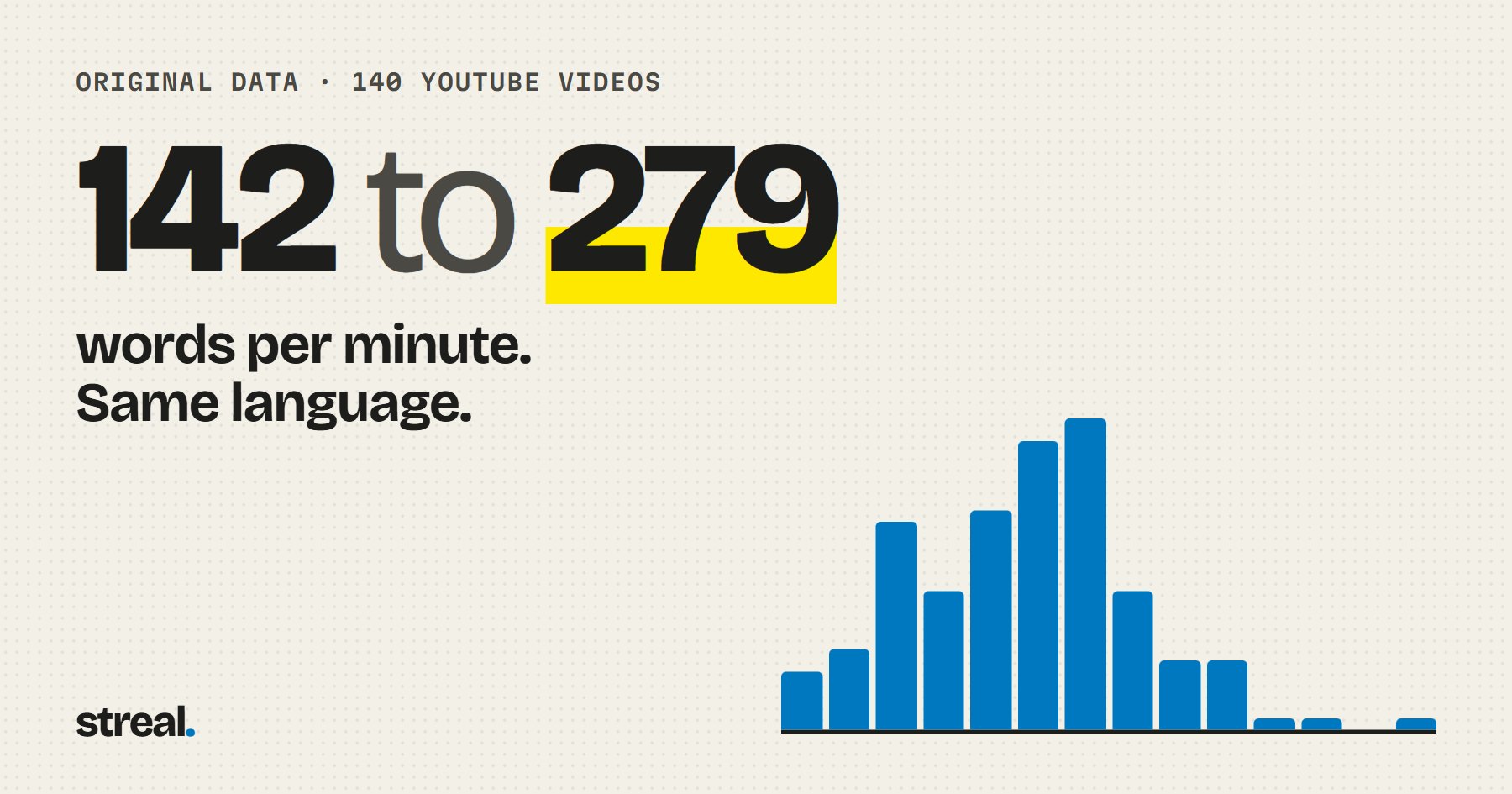
Spanish speakers on YouTube say a median of 194 words a minute while they are talking. English speakers say 201. So Spanish is not faster in words. It is faster in syllables, by about 30%, and that is what your ear is struggling with. The bigger surprise is how much speakers differ: the fastest video we measured runs at almost twice the speed of the slowest.
“Spanish speakers talk too fast” is possibly the most common complaint in language learning, and it is hard to find numbers for it. Most figures online come from lab recordings of people reading text aloud, or from radio bulletins. We could not find a measurement of what a learner actually meets on YouTube, so we made one, using the timing of every word across 32 hours of video.
| While speaking | Spanish | English |
|---|---|---|
| Median words per minute | 194 | 201 |
| Median syllables per second | 5.9 | 4.6 |
| Middle 80% of videos, words per minute | 161 to 223 | 171 to 237 |
| Slowest and fastest video | 142 and 279 | 143 and 275 |
| Videos and hours measured | 140 videos, 32 hours | 244 videos, 61 hours |
Same words per minute, 30% more syllables
The two languages look almost the same in words. The gap only opens when you count syllables: Spanish speakers get through about 5.9 a second and English speakers about 4.6, a ratio of 1.3.
That ratio is a useful check on our method, because a well-known study reached nearly the same one under very different conditions. Pellegrino, Coupé and Marsico (2011) had native speakers read translated texts aloud in a lab and found 7.82 syllables a second in Spanish against 6.19 in English, a ratio of 1.26. Their absolute numbers are higher than ours, partly because they strip out pauses more strictly. We got nearly the same answer from people on YouTube talking about tortillas and iPhones.
Their explanation applies here too. A Spanish syllable carries less information than an English one, so speakers use more of them to say the same thing, and the amount of meaning per second ends up close. So the speed you perceive is real, but it is a speed of sounds, not of ideas. That is good news. You do not have to think faster, you have to get better at cutting a fast stream of sound into words.
The real difference is between speakers
Spanish and English differ by 7 words a minute at the median. Two Spanish videos can differ by more than 130. The slowest video in our sample is a CuriosaMente explainer on philosophy, at 142. The fastest is a TiparracoSA comedy challenge, at 279. That is nearly double, and both are ordinary native Spanish.
So “I can’t understand Spanish speakers” is often too broad. Which speakers? If your only benchmark is comedy or a group conversation, you are measuring yourself against the far end of the range.
Which kinds of video are slowest
The pattern makes sense. Scripted videos read to a microphone are slowest, because the writer already has the sentence and the voice can take its time. Unscripted speech to a friend or an audience is fastest. Comedy tops the list because timing is the whole job.
There is a catch, and it matters for choosing what to watch. Slow speakers tend to use harder words. Across our 140 videos, faster speech goes with more common vocabulary (correlation +0.45, and +0.47 when we ran the same test on English). Explainers are slowest at 176 words a minute, but only 80% of their words are among the 1,000 most common. Street interviews run at 199 with 89% common words. We plotted every video on both axes in the best native Spanish channels, by speed and vocabulary.
Why it sounds even faster than it is
Words per minute measures the speaker. Your problem is usually segmentation: working out where one word stops and the next begins. Spanish makes that harder than most learners expect, because it links words together across their boundaries.
- A final consonant joins the next vowel. Los otros comes out as “lo-so-tros”. Nothing in the sound tells you where the first word ended.
- Vowels merge across words. Va a ir a Madrid can collapse into something close to “vai-ra-ma-drid”.
- Common words shrink. In casual speech para often becomes pa’, and in many regions cansado can end up as cansao.
This is why a learner who reads Spanish well can still lose a spoken sentence made entirely of words they know. The full version of this problem is in why you still can’t understand native speakers.
What to do about it
- Pick your speakers instead of waiting to catch up with all of them. A 142 is a very different listening task from a 279. Start at the slow end.
- Use 0.75×, and do not go lower. It takes the median 194 down to 146, which is about the pace of the slowest natural speech we found. Below that the audio distorts.
- Repeat short clips rather than adding hours. Understanding the same 90 seconds at full speed trains segmentation directly. Moving on to the next video does not.
- Look at your text with your ears on. Read the subtitle, then listen to how that sentence actually sounded. The distance between the two is exactly what you are trying to learn.
- Learn the most common forms as sounds. A short list of verbs does most of the work: five verbs account for 45% of the conjugated forms we counted, so you hear them constantly, usually reduced.
If you want the whole routine rather than the speed part, see how to learn a language with YouTube.
One way to get slow, level-matched clips
Streal, which is our product, is where these measurements came from: we use speech rate and vocabulary to decide which YouTube extract goes with which lesson, and the earliest lessons only get short extracts from slower speakers. You can start the first lessons with no account.
How we measured
The sample is 140 Spanish videos from 130 channels (32.4 hours, about 294,000 words) and 244 English videos from 244 channels (61.3 hours, about 602,000 words). YouTube’s automatic caption track gives a time for each word, and we used those times. Speaking time adds up the gaps between words and leaves out any gap over one second, so a long silence, a cooking shot or a burst of music does not make a speaker look slow. We dropped videos with too few words, with mostly non-speech audio, or whose written and automatic tracks disagreed too much to trust.
Please read the results with these limits in mind:
- It is not a random sample. We chose these videos for the Streal course: popular videos by native creators on subjects people want to watch, nearly all with caption tracks, with no language-teaching channels. They are a fair picture of what a learner would want to watch, not of Spanish speech in general.
- Automatic captions miss words, more often in fast speech and with several people talking, which probably understates the fastest videos.
- Syllables are estimated by rule, reliably in Spanish and less exactly in English, since English spelling is a poor guide to syllables.
- We do not compare countries. Our videos are not reliably labelled by the speaker’s origin, and many speak to several audiences.
- Each channel is usually one or two videos, so these are measurements of videos, not verdicts on creators.
Source: Pellegrino, Coupé & Marsico, A Cross-Language Perspective on Speech Information Rate, Language 87(3), 2011. All other figures are our own measurements, November 2026.
FAQ
How many words per minute do Spanish speakers say?
In our sample of 140 native Spanish YouTube videos, the median was 194 words per minute of speaking time. Eight videos in ten fell between 161 and 223. The full range ran from 142 to 279.
Is Spanish faster than English?
In syllables, yes: about 5.9 per second against 4.6 in our data, roughly 30% more. In words, no: 194 words per minute against 201. Spanish uses more syllables to say about the same amount, so the information arrives at a similar pace.
Do Mexicans speak slower than people from Spain?
We cannot answer that from this data. Our videos are not labelled reliably by the speaker’s country, and we would rather say so than guess. Differences between individual speakers and between genres are large enough that a single creator tells you little about a country.
Why does Spanish sound so fast?
Mostly because its syllables are short and simple, so more of them fit into a second, and because Spanish runs words together: the end of one word joins the start of the next, so you rarely hear a clean gap between them. Learners hear one long string of sound.
How can I get used to fast Spanish?
Start with slower genres such as explainers and cooking, use 0.75× playback, and rewatch the same short clip until you can follow it at full speed. Learning common words as they sound in connected speech helps more than extra hours of listening to something you cannot segment.