What to do after Duolingo, when the tree is finished and you still can’t hold a conversation
Finishing a Duolingo tree is a real achievement and it is also a specific, partial one. It leaves you with a particular shape of knowledge: broad passive recognition, thin production, and almost no exposure to speech at natural speed. Knowing exactly what is missing is what makes the next step obvious.
The honest summary of where the app leaves you: you can usually recognise common words in writing, you have met most of the basic grammar at least once, and you have very little ability to produce a sentence in real time or to follow one spoken at normal speed. That is not a failure of the app. It is what a tap-to-select exercise can and cannot train.
So the next block of work is not “another app”. It is the three things the format structurally could not give you.
What you actually have, and what you do not
| Skill | After a finished tree | Needed for B1 |
|---|---|---|
| Recognising written words | Usually solid | Solid |
| Vocabulary size | Roughly 1,500 to 2,500 words | Around 3,000 and climbing |
| Grammar you can name | Broad coverage | Broad coverage |
| Grammar you can use unprompted | Thin | The actual bar |
| Following speech at normal speed | Little to none | Required |
| Exposure to how words really sound together | Almost none | Required |
The pattern in that table is the whole problem. Everything the app trains is recognition of clean, isolated, written material. Everything B1 asks for is production and comprehension of messy, connected, spoken material. They are not adjacent skills, which is why people feel like they hit a wall rather than a slope.
Step 1: stop adding apps of the same shape
The most common next move is another gamified app, and it is the one that reliably wastes the next six months. If the format is the same, the ceiling is the same. Memrise, Busuu and the rest are not bad products; they are simply not a different kind of input, and a different kind of input is exactly what you now need.
The test for any candidate tool is blunt: does it put real, unmodified speech in front of you, and does it give you an order to meet it in? If it does neither, it is a fourth way of doing what you have already done.
Step 2: close the vocabulary gap with real input, not lists
You need roughly to double your vocabulary to be comfortable at B1, and word lists are a slow way to do it because they give you the word without the situation it lives in. Real input gives you both at once, and the word arrives already attached to a scene, which is most of what makes it stick.
The catch is that real input only works above a threshold of comprehension. Watching something you follow at 40% teaches you almost nothing, because you cannot tell which unknown word mattered. That threshold problem is the subject of how many words you need to watch without subtitles, and it is the reason step 3 exists.
Step 3: get an order, and make the input revise it
This is the part that turns the previous two into progress rather than activity. Learn one notion, deliberately, in sequence. Then go and find it in real speech, so it stops being a rule and becomes something you expect to hear. Then keep watching, and every later episode revises it for free.
The sequence matters because your grammar after an app is broad and shallow: you have met the subjunctive, you cannot deploy it. Going back through an ordered path is not repeating what you already know, it is converting recognition into use, and it is much faster the second time precisely because the recognition is already there.
A concrete version of steps 2 and 3
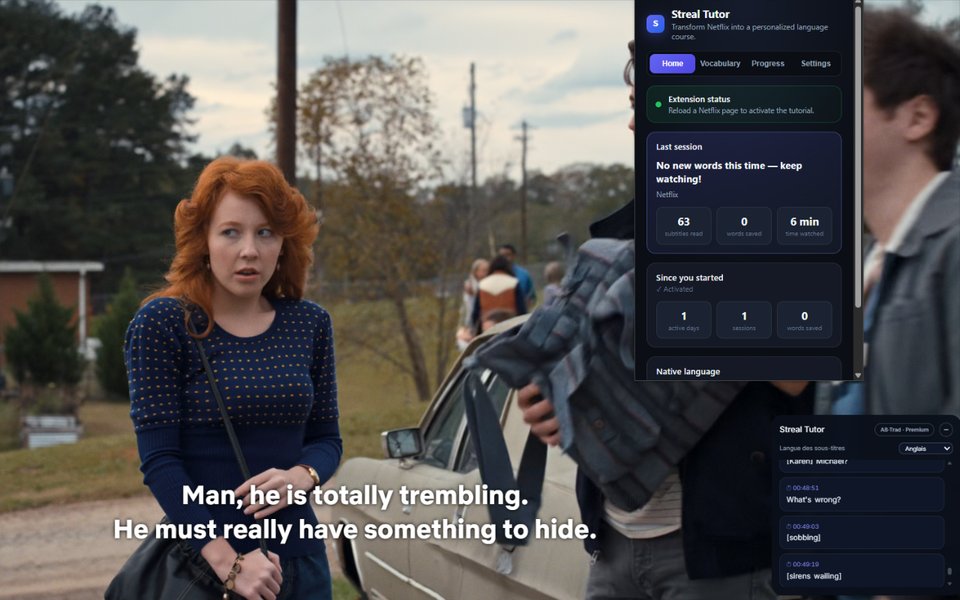
Streal runs both at once: an ordered course of 32 chapters from A1 to C2, where every lesson ends on the real Netflix lines that contain the notion it just taught, with the timecode, so you meet it in unmodified speech the same minute you learn it. Because you have already met most of A1 and A2, you will move through the early chapters fast, which is the point: the tests tell you where recognition stops and use begins.
Chapter 1 is free in full, so you can check that against your own level before spending anything.
A realistic order of operations
- Diagnose, do not assume. Take a placement test or work through an A2 chapter you think is beneath you. Most post-app learners find their recognition is B1 and their production is A2, and that gap is the thing to work on.
- Pick one show and stay with it. Same cast, same register, same recurring vocabulary. Switching shows every episode resets the specialised vocabulary you were starting to acquire.
- Watch with both languages on screen, not one. Below B1, target-language subtitles alone are decoding practice, not listening practice.
- Keep the course running alongside. Twenty minutes of ordered lessons plus an episode beats an hour of either on its own.
- Start producing early and badly. Nothing in this article substitutes for speaking, and the longer you defer it the more the recognition and production gap widens.
How long to B1
Honestly: it depends on hours, on how much of each hour you comprehend, and on whether you produce as well as consume. A commonly cited figure is one to two years at around five hours a week to reach B1 from scratch, and a finished tree means you are not starting from scratch. What that does not tell you is whether your particular five hours are the right five hours, which is the only variable you control.
The wider diagnosis of why speech in particular stays hard is in why you still cannot understand native speakers, and the month-by-month version of the plan above is in the A1 to B2 study plan.
FAQ
Is Duolingo enough to become fluent?
No, and it does not claim to be. It is a good vocabulary and early-grammar habit builder. Fluency requires production and exposure to unmodified speech, neither of which a tap-to-select exercise trains.
Should I restart at A1 or jump to B1 material?
Start where your production is, not where your recognition is. For most people finishing a tree that means revisiting A2 quickly rather than starting B1 cold. A chapter test is a faster way to find out than a self-assessment.
Can I just watch TV shows from here?
Not alone, at this level. Watching works once you follow most of what you hear, and after an app you typically do not yet. Pairing it with an ordered course is what makes the watching count as learning rather than exposure.
How much vocabulary do I need to add?
Roughly double. Research on English television puts the most frequent 3,000 word families at around 95 percent coverage of dialogue, and a finished app course commonly leaves you somewhere between 1,500 and 2,500.