How many words do you need to watch TV and YouTube without subtitles?
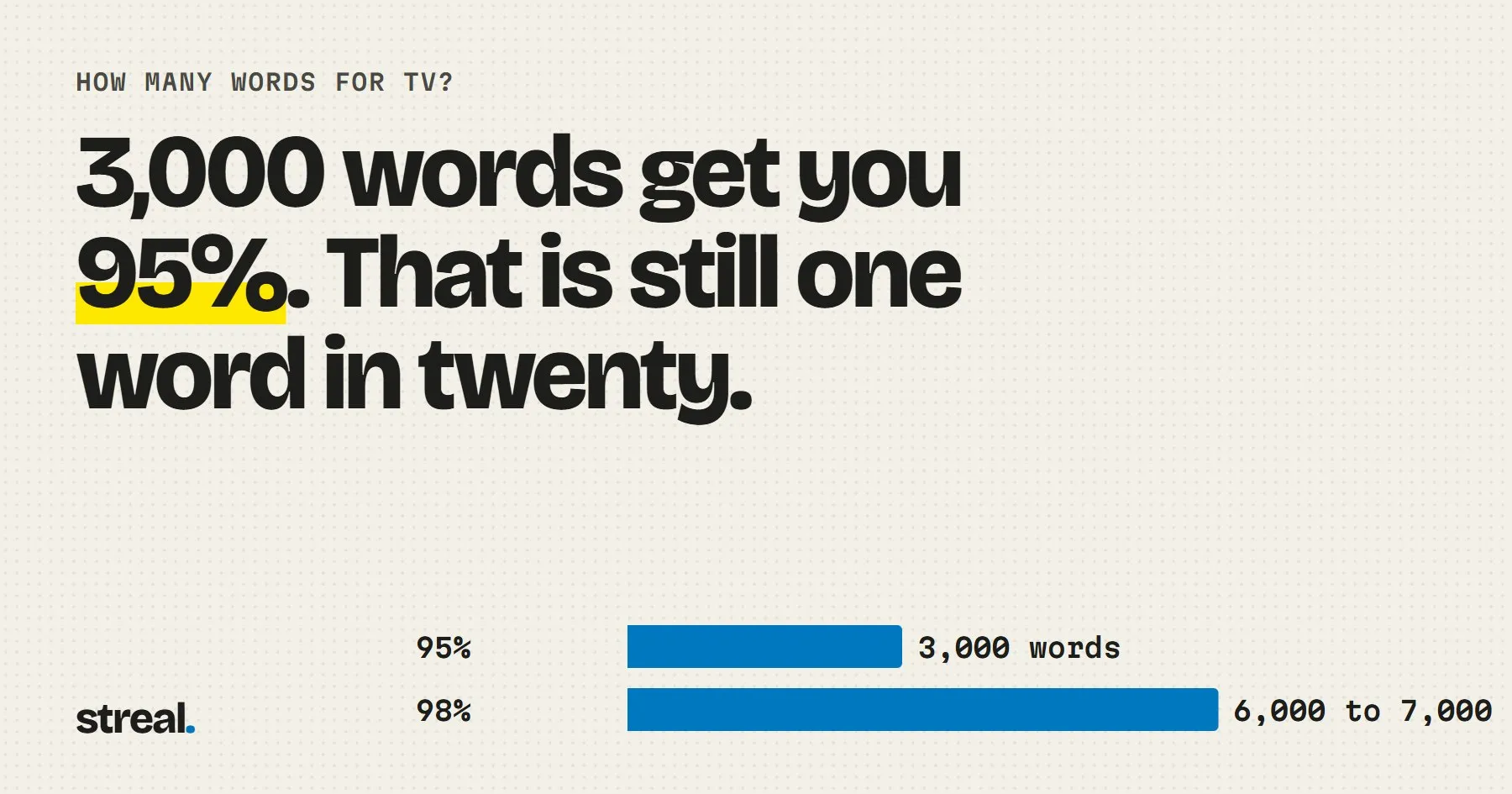
There is an actual answer to this, measured rather than guessed, and it is more demanding than most learners expect. The short version: around 3,000 word families gets you to 95% of television dialogue, and 95% is not nearly as comfortable as it sounds.
Two pieces of research do most of the work here, both on English material.
Webb and Rodgers analysed 88 television programmes totalling 264,384 running words. They found that knowing the most frequent 3,000 word families, plus proper nouns and marginal words, gave 95.45% coverage of the dialogue. The requirement varied by genre, from about 2,000 to 4,000 word families for 95% coverage, and from 5,000 to 9,000 for 98%.
Nation, looking at the broader question of how much vocabulary comprehension requires, put 98% coverage of spoken text at 6,000 to 7,000 word families, and written text at 8,000 to 9,000. 98% is the level generally treated as enough for unassisted comprehension, where you can infer the remaining unknowns from context without losing the thread.
Sources: Webb & Rodgers, Vocabulary Demands of Television Programs, Language Learning 59(2), 2009; Nation, How Large a Vocabulary Is Needed for Reading and Listening?, 2006. Both study English. The figures for French or Spanish will differ in detail, and the structure of the problem does not.
We checked it on YouTube
Both studies are about English television, so we ran the same kind of count on Spanish: 140 videos by native creators on YouTube, about 290,000 words. To keep the list honest, the frequency ranking was built on half the channels and measured on the other half.
| Most common words known | Share of speech covered | Unknown words |
|---|---|---|
| 500 | 80% | 1 in 5 |
| 1,000 | 85% | 1 in 7 |
| 2,000 | 90% | 1 in 10 |
| 3,000 | 92% | 1 in 12 |
| 5,000 | 94% | 1 in 16 |
Here a “word” counts hablo and hablar as one, which is close to a word family but not identical, and names count as known. The curve has the same shape as the research on English: the first thousand words do a huge share of the work, and every step after that buys less. Reaching 95% took about 8,000 words in our sample, because spoken Spanish on YouTube is full of names, places, brands and slang that no frequency list ranks highly. The method is described in how we measured.
Why 95% feels so much worse than it sounds
This is the part worth sitting with, because the percentages are misleading in ordinary use.
95% coverage means one word in twenty is unknown. A line of subtitle is often around ten words, so that is an unknown word roughly every other line. In a 45-minute episode, that is several hundred moments where you either stop and lose the next line, or let it go and accept a gap.
98% coverage means one word in fifty, or roughly one every five lines. That is the difference between following a story and reconstructing one. The gap between those two experiences is enormous, and it costs somewhere between 3,000 and 6,000 additional word families to cross.
| Coverage | Roughly | What an episode feels like |
|---|---|---|
| 80% | 1 unknown word in 5 | Noise with occasional recognisable words |
| 90% | 1 in 10 | You get the topic, not the plot |
| 95% | 1 in 20, about one per other subtitle line | Followable with effort, exhausting for a full episode |
| 98% | 1 in 50 | Comfortable, context fills the gaps |
Word families, not words
A word family is a base word plus its inflections and obvious derivatives, so watch, watches, watched, watching is one family, not four. This matters because it makes the numbers sound smaller than the raw vocabulary they imply, and because vocabulary apps typically count items, not families. A claim of “5,000 words learned” from a flashcard app is not 5,000 word families.
Genre changes the number more than you would think
The 2,000 to 4,000 range for 95% coverage is a wide one, and it is worth exploiting. Material with a narrow, repeated vocabulary sits at the bottom of the range: sitcoms set in a flat, everyday drama, anything where the same characters discuss the same domestic subjects every week. Material with specialised vocabulary sits at the top: crime procedurals, medical and legal shows, science fiction, news.
The practical consequence is the strongest single tip in this article. Watch narrowly. Staying with one series for many episodes means the specialised vocabulary you pay to learn in episode one keeps paying you back in episodes two through twenty. Jumping between titles resets that each time.
How to actually get from 2,000 to 6,000
Word lists are the obvious route and a slow one, because they give you a word without the situation that makes it memorable. Volume of real input is faster per hour, with one condition: it only works above the comprehension threshold. Input at 50% coverage teaches you very little, because you cannot tell which unknown word carried the meaning.
That creates the bind this whole article circles: you need input to get vocabulary, and you need vocabulary to use the input. The way out is to bridge the gap artificially rather than wait to be ready, which means watching real content with both languages on screen, so every line is comprehensible while your own coverage is still climbing. We went through why waiting does not work in why immersion alone does not work at A1 and A2.
Turning a video into vocabulary you keep
Streal, our product, does this on YouTube. Both languages run under the video, you can click any word for its meaning, and each lesson’s extracts are picked so that what you just learned keeps coming back. Words you meet again in scenes you remember survive far better than words on a list, which is the entire argument for learning them this way. It is free to start, and the first lessons need no account.
The honest summary
- Around 3,000 word families gets you to roughly 95% of television dialogue, which is followable but tiring.
- Around 6,000 to 7,000 gets you to 98% of spoken material, which is comfortable.
- That upper figure lines up with a strong B2 or C1, which is why B1 to B2 is the long plateau.
- Genre and narrow viewing can move you a full level of comfort without learning a single extra word.
If the numbers above are discouraging, the useful reframe is that they are a description of a distance, not of a difficulty. The distance closes with hours of comprehensible input, and the only real question is whether your hours are spent on material you mostly understand. The A1 to B2 study plan is the version of that with dates on it.
FAQ
How many words do I need to be fluent?
For comfortable comprehension of spoken material, research puts 98% coverage at roughly 6,000 to 7,000 word families. Fluency in the speaking sense needs less vocabulary than that but much more retrieval speed, which is a different kind of practice.
Do these English figures apply to Spanish or French?
The exact numbers will differ, since the studies measured English television. The structure holds: a few thousand word families gets you most of the way, the last few percent of coverage costs several thousand more, and genre changes the requirement substantially.
Is it better to learn the 3,000 most frequent words first?
Frequency order is a genuinely efficient starting point, because the most common words do disproportionate work. It stops helping around the 3,000 mark, where what you need becomes specific to the material you actually watch and read.
Do subtitles in the target language count as reading or listening?
Mostly reading, which is why target-language subtitles alone can flatter your sense of progress. They are still useful, because seeing and hearing the same line is what teaches you where the word boundaries fall in speech.