
Why immersion alone doesn’t work at A1 and A2
“Just watch a lot of TV in the language” is advice that works, and it works at a level most of the people receiving it have not reached. At A1 and A2 it usually produces a few frustrated weeks and a quiet return to dubbed audio. The reason is not effort, and understanding it saves you months.
The advice descends from a real idea: you acquire a language largely by understanding messages in it, and the input that teaches you most is input slightly above your current level. That is sound, and it is also where the popular version goes wrong, because it quietly drops the word understanding.
Native television is not slightly above A1. It is several levels above it, delivered at speed, with no concessions. It is not comprehensible input for a beginner. It is noise with pictures.
What goes wrong, concretely
Unknown words arrive faster than you can resolve them
At a beginner vocabulary, a typical line of dialogue contains several words you do not know. Each one costs you the rest of the line while you process it, so you lose the sentence you were in and the start of the next. Twenty minutes of that is exhausting and teaches very little, because you cannot tell which of the unknown words was the one that mattered.
You cannot tell where words end
Beginners learn words as separate units. Speech does not deliver them that way: endings drop, vowels reduce, and neighbouring words merge. You can know a word perfectly and still fail to notice it went past, which means repetition does not accumulate the way it is supposed to. Exposure only teaches you a word if you register that you heard it.
Nothing arrives in a useful order
A scene contains whatever grammar the scene needed. For an intermediate learner that is an advantage, because it is revision of many notions at once. For a beginner it is a stream of structures with no foundation under them, and no way to tell which are worth attention.
The threshold immersion needs
Input works when you understand most of it and can infer the rest. Studies of English television put the most frequent 3,000 word families at around 95% coverage of dialogue, with 98% needing considerably more, and 98% is roughly the level at which you can follow unassisted. Below that, you are not inferring, you are guessing.
The figure worth internalising is that even 95% coverage leaves about one unknown word per subtitle line. That is why immersion feels so much harder than the percentage suggests, and it is covered in more detail in how many words you need to watch without subtitles.
What to do instead, until you meet the threshold
The answer is not to abandon real content, which would waste its main advantage: it is the only place the language actually sounds like itself. The answer is to change what you do with it.
Make the input comprehensible instead of waiting to be ready for it
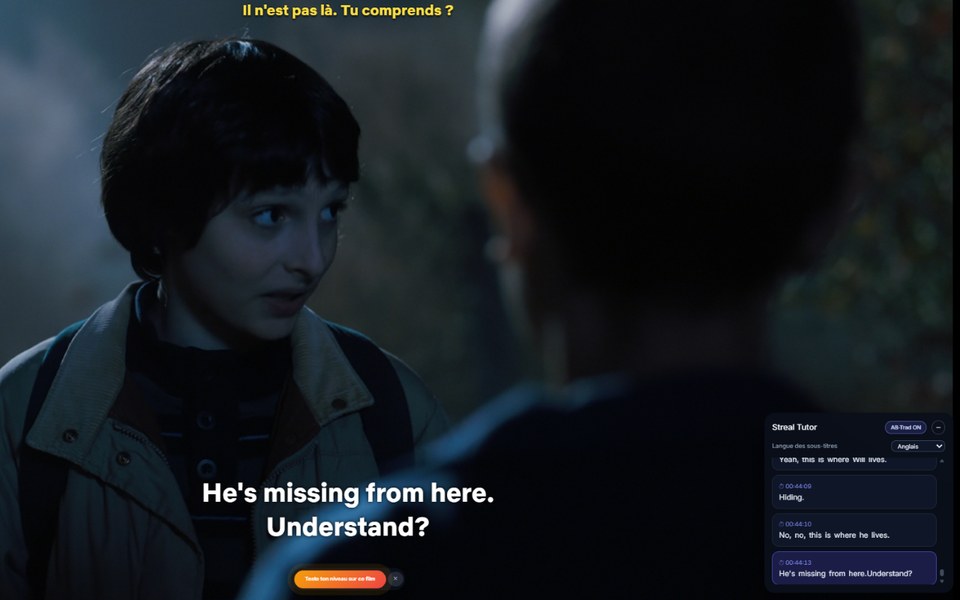
Both languages on screen at once, so every line is understood as it passes. This is the single change that turns native content from noise into usable input at a beginner level, because it removes the segmentation problem and the unknown-word problem in one move.
Bring your own order
Decide what you are learning this week from a sequence, not from what happened to be in episode four. Then let the episode be where you meet it, rather than where you discover it.
Watch narrowly
One series, many episodes. Same actors, same register, same recurring vocabulary. Narrow viewing recycles vocabulary far more than jumping between titles, which is exactly what a beginner needs.
Where this leaves the “just watch TV” advice
It is not wrong, it is late. It is what to do from roughly B1 onward, when your coverage is high enough that context does the work. Given to an A1 learner it is a recipe for concluding they are bad at languages, when in fact they were handed a task nobody at their level can do.
The version that works earlier is the same content with the comprehension gap bridged and an order laid over the top. That is what Streal does: 32 ordered chapters from A1 to C2 where each lesson ends on real Netflix lines containing the notion just taught, with timecodes, plus dual subtitles while you watch so the content stays comprehensible before you have the vocabulary to make it so on your own. It also deliberately withholds notions you have not reached yet rather than flagging grammar you have no foundation for.
For the practical week-by-week version of this, see the A1 to B2 study plan, which sets out how much of your time should go to ordered lessons versus watching at each level. The general listening diagnosis is in why you still cannot understand native speakers, and the method for getting value out of an episode is in how to learn a language with Netflix.
FAQ
Does comprehensible input work?
Yes, with the emphasis on comprehensible. Input you largely understand drives acquisition well. Input you mostly do not understand is not a weaker version of the same thing; it is a different and much less productive activity.
At what level can I start watching native shows normally?
Roughly B1 with support such as dual subtitles, and around B2 without. Below that you can still watch, but you need the comprehension gap bridged for it to count as input rather than exposure.
Are learner-aimed podcasts better than TV for beginners?
For pure listening, yes, because they are pitched at your level, which is the whole point of comprehensible input. They are also less interesting to most people, and material you keep coming back to beats optimal material you abandon.
Should I use subtitles in my own language?
Alone, they let you follow the plot while learning very little, because you read instead of listening. Paired with target-language subtitles they become useful, since you can see what was said and what it meant at the same time.