Preterite vs imperfect: the rule that works, and how natives actually choose
Short action, preterite; long action, imperfect. It is the shortcut every learner is given, and it is wrong often enough to be useless. Here is the rule that holds, checked against 40,516 verbs spoken by natives on YouTube, with the clips to hear it.
Every Spanish course teaches the difference between the preterite (hablé) and the imperfect (hablaba). Most of them teach it with a shortcut that breaks within a week: short actions take the preterite, long ones take the imperfect. Then you hear viví en Madrid diez años and the shortcut is gone.
This article gives you the rule that holds, then checks it against what native speakers actually say. We tagged every conjugated verb in 140 Spanish YouTube videos by Spanish-speaking creators, about 32 hours of speech, and played back the lines where both tenses meet.
What natives actually use
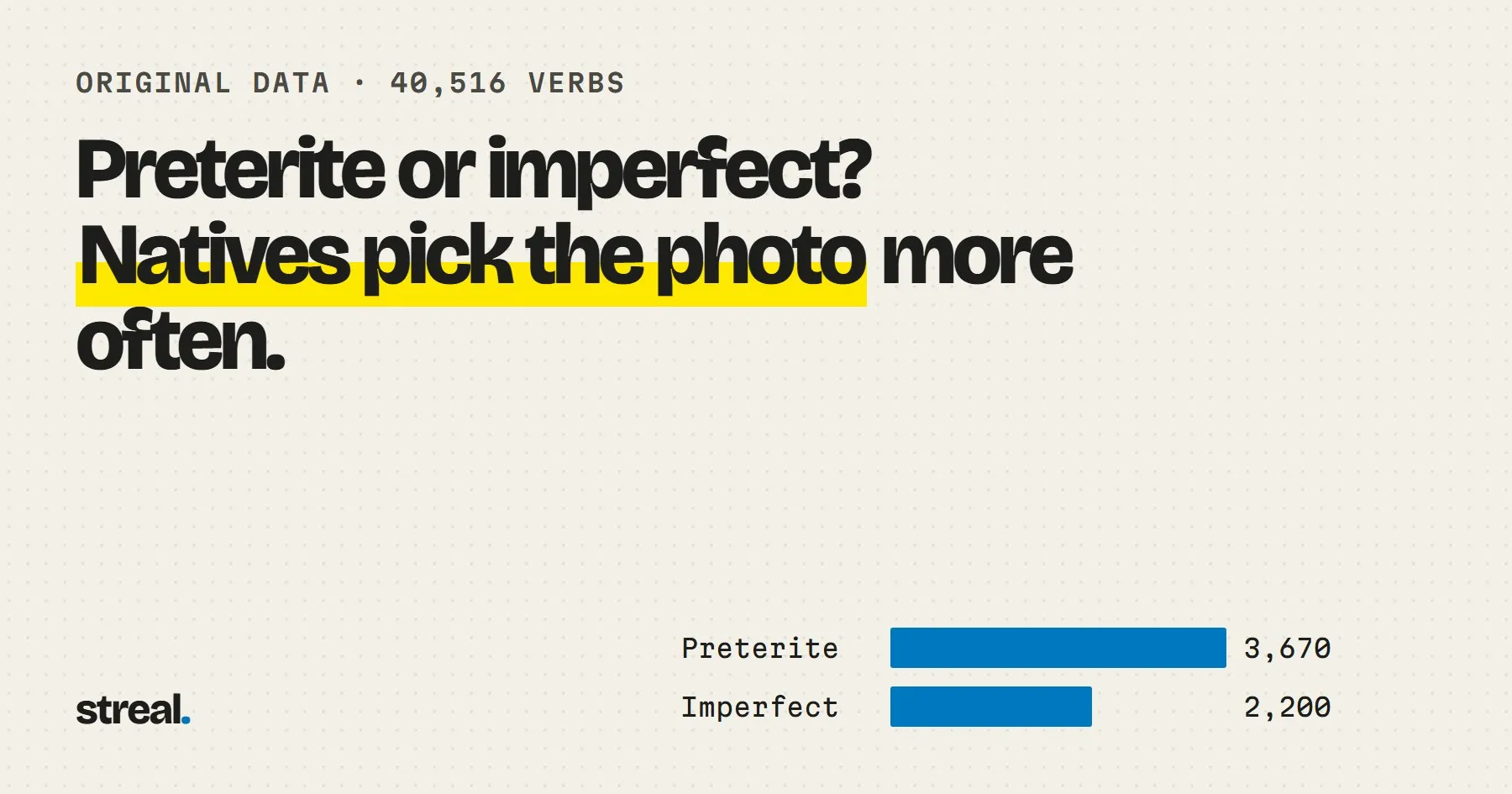
Out of 40,516 conjugated verbs, two thirds are in the present. The past is a smaller slice than learners expect, and inside it the preterite wins clearly.
Put the two together and you get 5,870 past-tense verbs: about five preterites for every three imperfects. That ratio is the first useful fact. When you are unsure and the sentence moves a story forward, the preterite is the safer bet. The imperfect is the tense of background, and stories have more events than backdrop.
The rule that holds: a photo or a film
Forget length. Ask how you are framing the action in your story.
- Preterite: a photo. The action is a closed block. It starts and ends inside what you are telling, and it moves the story on: llegó, abrí la puerta, se fue.
- Imperfect: a film already running. You step into a scene in progress and describe it: the setting, the time, someone’s age, what used to happen, what was going on when something else happened.
That is why viví en Madrid diez años takes the preterite: ten years, but presented as a finished chapter. And vivía en Madrid takes the imperfect: the same fact, but as the background to something else (vivía en Madrid cuando conocí a Ana).
Heard in real Spanish
These lines come from the videos we analysed. Preterite and imperfect are both lit up; press play and listen to how differently they sit in the sentence.
Fui a Disneyland cuando tenía 12 años.
I went to Disneyland when I was 12 years old.
Photo: fui. Background, an age: tenía.
PRONUNCIAS MAL ESTAS MARCAS?? | Superholly by superholly · Watch on YouTube
Estaban en sesión de peloteo cuando a alguien se le ocurrió la palabra googolplex.
They were in a brainstorming session when someone came up with the word googolplex.
Film running: estaban. The event that cuts in: se le ocurrió.
PRONUNCIAS MAL ESTAS MARCAS?? | Superholly by superholly · Watch on YouTube
Era una isla hasta el siglo 20, pero un terremoto la unió al continente.
It was an island until the 20th century, but an earthquake joined it to the mainland.
A state that lasted centuries: era. One event ends it: unió.
Especial fronteras: los récords y curiosidades más increíbles by Un Mundo Inmenso · Watch on YouTube
Mi mamá Dorita, que murió a los 99, me lo decía siempre.
My mom Dorita, who died at 99, always told me that.
Once, closed: murió. Again and again: decía siempre.
Nunca pidas permiso | Ronald Shakespear | TEDxRiodelaPlata by TEDx Talks · Watch on YouTube
The second clip is the most common pattern of all, and the one worth learning as a template: imperfect + cuando + preterite. Something was going on, then something happened. The fourth shows the other big use of the imperfect: habits, often flagged by siempre, todos los días or de niño.
Six contrasts that cover most cases
| Idea | Imperfect (film) | Preterite (photo) |
|---|---|---|
| Habit vs one time | De niño, iba al parque los domingos. | Ayer fui al parque. |
| Description vs step in the story | La casa era pequeña. | Entré en la casa y cerré la puerta. |
| Background vs finished block | Vivía en Madrid. | Viví en Madrid diez años. |
| In progress vs interruption | Cenaba… | …cuando llegó mi hermano. |
| Age and time | Tenía doce años. Eran las tres. | Rarely |
| A sequence of events | No | Me levanté, me duché y salí. |
Four verbs that change meaning
With a handful of verbs, the tense does not just reframe the action, it changes what the verb means. These come up constantly in conversation.
| Verb | Imperfect | Preterite |
|---|---|---|
| saber | Sabía la verdad. I knew the truth. | Supe la verdad. I found out the truth. |
| conocer | Conocía a Ana. I knew Ana. | Conocí a Ana. I met Ana. |
| querer | Quería salir. I wanted to go out. | No quiso salir. He refused to go out. |
| poder | Podía abrirla. I was able to (in general). | Pude abrirla. I managed to. |
The mistakes learners make most
Vivía allí cuarenta años.Viví allí cuarenta años. A period presented as finished is a photo, however long.Fue alto y tenía el pelo negro.Era alto y tenía el pelo negro. A description is background.Cuando era niño, fui al parque cada domingo.Cuando era niño, iba al parque cada domingo. A habit is a film on repeat.
A quick check
- Ayer ___ (ir) al mercado. Answer: fui. “Ayer” closes the action.
- ___ (hacer) frío y ___ (llover). Answer: hacía, llovía. Weather as a backdrop.
- Leía cuando ___ (sonar) el teléfono. Answer: sonó. The event that cuts into the scene.
Learn the forms, then hear them
If the forms themselves are shaky, start with the notion pages for the preterite, the irregular preterites and the imperfect, each with two native clips. The full lesson on choosing between them is in the Streal course, chapter 9, with extracts where both tenses keep coming back.
How we counted: 140 videos by 130 Spanish-speaking creators on YouTube, 294,219 words in total, analysed with spaCy’s Spanish model. Only conjugated verbs are counted. The tagger has known blind spots (it reads the filler o sea as a subjunctive, for instance), and we corrected the ones we found on a hand-checked sample. The full method is in how we measured.
FAQ
What is the difference between the preterite and the imperfect in Spanish?
The preterite presents a past action as a closed block that moves the story forward (fui, llegó). The imperfect describes the background: settings, ages, habits, and what was going on when something else happened (era, tenía, iba).
Is the preterite for short actions and the imperfect for long ones?
No. Length does not decide. “Viví en Madrid diez años” uses the preterite because the ten years are presented as a finished chapter. What decides is whether you show the action as a closed event or as an ongoing background.
Which is more common, the preterite or the imperfect?
In our sample of 140 Spanish YouTube videos, the preterite came up about five times for every three imperfects: 3,670 against 2,200, out of 40,516 conjugated verbs. The present tense made up two thirds of everything.
How do you use “cuando” with the preterite and the imperfect?
The classic pattern is imperfect + cuando + preterite: “Estaban en una reunión cuando se le ocurrió la idea.” The imperfect sets the scene, the preterite is the event that interrupts it.
Which verbs change meaning between the preterite and the imperfect?
The common ones are saber (knew / found out), conocer (knew / met), querer (wanted / no quiso: refused) and poder (was able / managed to).